
Internal Review Processes and Demand Management
Information around the University’s internal process which exist to support prospective applicants to some of the larger regularly recurring funding schemes can be found below.
If you are interested in a particular funding opportunity, please contact your relevant Research Development Manager. who will be able to provide advice on any internal competitions, funder requirements and assist you in preparing your application.
The 4 areas covered on this page are:
- BBSRC Standard Grants
- NERC Pushing the Frontiers
- AHRC and Leverhulme Trust Grant Development College
- Prosperity and Resilience Grant Development College
Apply for funding to support excellent investigator-led research across the breadth of the Biotechnology and Biological Sciences Research Council (BBSRC) scientific remit.
This funding opportunity operates on a rolling basis and has no fixed closing date.The full economic cost (FEC) of projects can be up to £2 million. Funding is available for up to five years. BBSRC will fund 80% of the FEC.
This funding opportunity includes a number of funding schemes as outlined below:
New investigator award
The New Investigator award is designed primarily to assist newly employed university lecturers, researchers in research council institutes (at a level equivalent to lecturer), and fellows (at a level equivalent to lecturer) to secure their first major element of research support funding.
LINK and Industrial Partnership Award (IPA)
- LINK supports collaborative research projects between at least one company and one academic partner. At least 50% of the full project cost comes from industry.
- IPA encourage and support collaboration between academic research groups and industry. IPAs are academic-led, applicant-led mode grants that have significant industrial involvement and industry partners that contribute in cash at least equivalent to 10% of the full project costs. International agreements
International agreements
You can apply for funding through the BBSRC Standard Grants scheme with the following international bodies:
Internal Expression of Interest (EoI) Support Process
If you wish to apply as Principal Investigator, you must complete the BBSRC Info-timeline-EoI Form - Open call V4.docx and provide one R4RI (Résumé for Research and Innovation) format CV for all named applicants. Please submit both documents to James Church.
Please allow approximately 12 weeks between submission of your EoI to completion of the full application. The aim of the support process is to:- provide transparent, constructive, and effective support for applicants;
- enable a wide range of researchers to benefit from working collaboratively on proposals;
- increase, over time, the proportion of applications that are successfully funded; and
- encourage greater engagement with BBSRC funding opportunities across the University.
Applications led by the University of Reading that do not engage with this process will not be permitted to submit.
This approach aligns with BBSRC expectations that institutions have clear internal processes in place to support application development and demand management, ensuring that submissions are competitive and of high quality.
Applicants must nominate two Mentors and obtain their agreement in advance. Further information on mentorship is provided in Appendix 2: Frequently Asked Questions in the EoI form.
Outline of Process
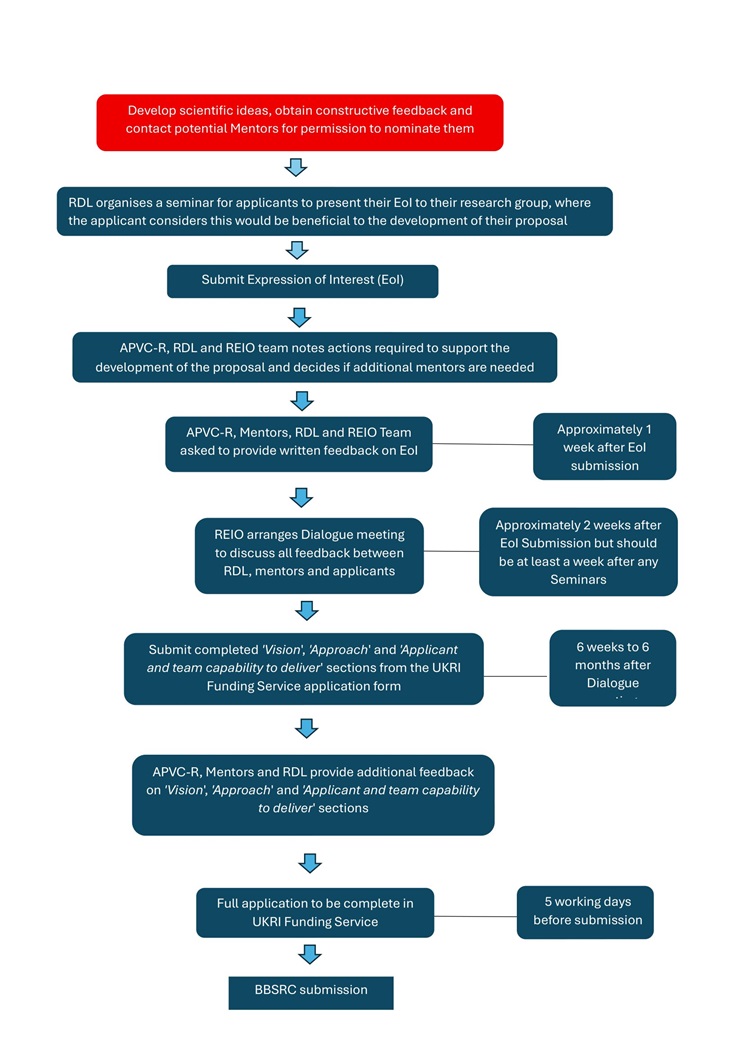
- Early discussion and project development
Applicants should discuss their proposed project and its requirements with their Research Division Lead (RDL), relevant colleagues, and Research Development Manager (RDM) at an early stage. This initial engagement will help shape the proposal and ensure it is appropriate for this funding opportunity before the EoI is developed. - Optional seminar presentation
Project teams may choose to present their ideas in a seminar format (e.g. within their department), followed by a Q&A session. The nominated mentors, relevant RDL(s), and an RDM should attend, with the RDL acting as Chair. - EoI submission and mentoring support
Applicants submit their EoI, supported by nominated mentors. Mentors, RDLs, Associate Pro-Vice-Chancellor for Research (APVC-R) and the Research, Engagement & Innovation Office (REIO) team will provide written feedback on the EoI. Where appropriate, additional expertise may be sought; this will be discussed with the PI in advance. - Dialogue meeting
A dialogue meeting will be held with the applicant team rather than relying solely on written feedback. This session provides an opportunity for the panel and applicants to:- Discuss questions arising from the EoI and associated feedback
- Clarify any misconceptions
- Explore key aspects of the proposal, such as the science case, timeliness, feasibility, level of risk, resource requirements, and presentation
- Applicants will be given advance notice of key discussion points identified by the mentorship team to allow time for preparation. This session is intended to support and strengthen applications rather than holding them back.
- Vision and Approach section review
Applicants submit their 'Vision', 'Approach' and 'Applicant and team capability to deliver' sections from the UKRI Funding Service application form. Mentors, RDLs, APVC-R and the REIO team to provide written feedback on the 'Vision', 'Approach' and 'Applicant and team capability to deliver' sections.
This flow diagram outlines the indicative timeline and key stages of the process. The timeline is intended as a guide and remains flexible, with adjustments made as needed to reflect the requirements of individual applications.
NERC Pushing the Frontiers
Pushing the Frontiers (PtF) is one of NERC’s primary methods of responsive mode funding. The scheme is intended for projects having full economic costs of up to £950k, of which NERC will fund 80%. The scheme is open continuously, with no deadlines set by the funder.
Colleagues at Reading who are planning to lead a proposal are required to follow the University’s application development process (formerly EoI process). The main aim of this process is to ensure that all NERC Pushing the Frontiers applications submitted are as competitive as possible. This is especially important since the introduction of a new resubmissions policy by NERC which means that unsuccessful applications can only be invited by NERC for resubmission, and so effectively applications only have one chance of success. Centred on peer review, the process is primarily intended to provide advisory support to applicants but also with awareness that NERC could potentially apply a submission cap if Reading are not sufficiently successful in our submissions.
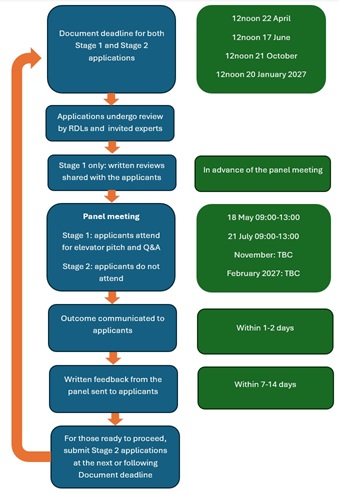
The process helps applicants to get a sense of how their proposal might be received if it were to be submitted to NERC. By submitting a Stage 1 application (formerly EoI), applicants have the chance to receive the views and feedback of their peers at an early stage of writing a grant application, after the proposed research has been conceptually developed but before the investment of a significant amount of time and effort in writing a full proposal. The panel provides written feedback and advice to all applicants to support them going forward.
The overall aims of the process are to ensure that only those applications that it is felt will have a reasonable chance of success are submitted to NERC, and that those submitted are as competitive as they can possibly be. While the process necessarily involves assessments being made, the aim is to support colleagues to the next stage by being a ‘critical friend’ and providing guidance for the development of their proposal.
The process can also have a more flexible and developmental element; a Research Division Leader, mentor or Research Development Manager might provide more informal feedback on a Stage 1 application at any stage, ahead of the review process and panel meeting.
The diagram below summarises the main steps involved in the application development process. This process was introduced in March 2026 in response to changes made to this call by NERC. We intend to run it on a trial basis for 12 months. We would welcome feedback on this process so that we can refine and develop it.
For more information about the NERC PtF application development process, please contact Ali Brown, Assistant Research Development Manager in REIO (a.k.brown@reading.ac.uk).
AHRC and Leverhulme Trust Grant Development College (Heritage & Creativity Theme)
The Grant Development College is an internal review process to support the development of AHRC Standard Grants, AHRC Catalyst Awards and Leverhulme Trust Research Project Grant (RPG) applications, with the aim of improving their chances of success. All grants led by Reading to be submitted to these schemes must go through the Grant Development College before submission.
Applicants should first submit a Stage 1 application, which is read by a reviewer outside the PI's discipline, someone within their department and a specialist Digital Humanities reviewer, if required. Research Division Leads, alongside the Research Development Manager and the APVC of Research will compile feedback for the applicant within 4-6 weeks of submission. Leverhulme RPG outline applications can then be submitted to the funder (see link below to the Leverhulme Trust's website for further guidance).
For AHRC standard grants and catalyst grants, the full application is reviewed in Stage 2. AHRC changed the format of their submissions in June 2023, and the stage 2 application now follows this format. Please complete the stage 2 proforma below, and see AHRC's website for further guidance (under 'How to apply' in the link below)
If you wish to submit an application, please discuss with your Research Development Manager, then use the relevant template below and submit in time for an upcoming deadline. Please note that the proformas below have been updated (July 2025). Please use the new versions below:
Upcoming Deadlines: 5th October 2026 and 7th December 2026
Prosperity and Resilience Grant Development College
The Grant Development College is an internal review process to support the development of UKRI Responsive Mode* Grant applications and Leverhulme Trust Research Project Grant (RPG) applications, with the aim of improving their chances of success. All grants led by Reading to be submitted to these schemes must go through the Grant Development College before submission.
Applicants should first submit a Stage 1 application, which is read by a reviewer outside the PI's discipline and someone within their department. Leverhulme RPG outline applications can then be submitted to the funder. For UKRI Responsive mode grants, the Vision and Approach section is reviewed in Stage 2 of this process, and then the complete UKRI application form in Stage 3. Feedback will be provided within three weeks of submission for each stage.
If you wish to submit a Stage 1 application, please discuss with your Research Development Manager, then use the relevant template below and submit at any time.
* UKRI schemes where the choice of topic lies with the applicant (bottom-up funding) and there are usually no deadlines. Schemes include: AHRC Standard Research Grants; AHRC Catalyst Awards; AHRC Curiosity Awards; ESRC Research Grants; ESRC New Investigator Grants; ESRC Secondary Data Analysis Grants; EPSRC Research Grants.